
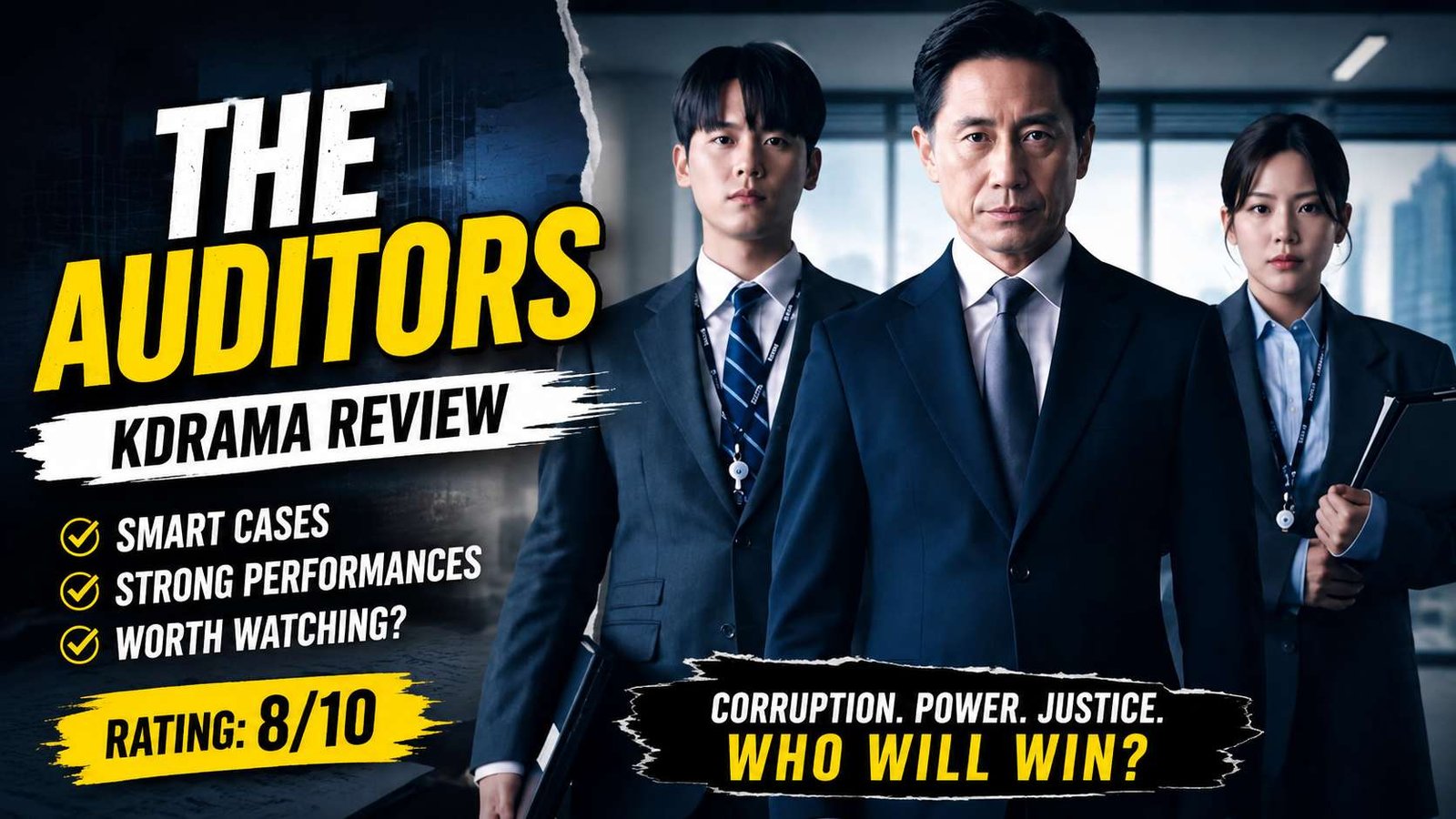
Absolutely. I’ll make it original rather than paraphrasing the two reviews, with a catchy introduction, detailed plot discussion, character analysis, strengths/weaknesses, and a conclusion that works well for a K-drama review website.
The Auditors (2024) Review: A Sharp, Entertaining Office Thriller That Deserves More Attention
Drama: The Auditors
Korean Title: 감사합니다
Year: 2024
Genre: Office, Drama, Crime, Mystery, Comedy
Episodes: 12
Starring: Shin Ha Kyun, Lee Jung Ha, Jin Goo, Jo Aram
Rating: ⭐ 8/10

This review may contain spoilers.
If you hear the word “auditor” and immediately imagine spreadsheets, paperwork, meetings, and people arguing over financial records, The Auditors might initially sound like the kind of drama that would put you to sleep.
Surprisingly, it does the exact opposite.
Instead of presenting auditing as a slow corporate process, The Auditors turns it into a tense battle against corruption, hidden agendas, fraud, workplace politics, and people who will do almost anything to protect their interests.
At the center of the story is Shin Cha Il, a highly skilled and intimidating auditor who joins JU Construction’s audit team. He has little patience for excuses and even less interest in making friends. Alongside him is Goo Han Soo, a much warmer and more inexperienced employee whose personality is almost the complete opposite of Cha Il’s.
And that contrast becomes one of the best parts of the drama.
What Is The Auditors About?
The Auditors follows an audit team working inside a massive construction company where corruption and misconduct are far more common than anyone wants to admit.
When Shin Cha Il arrives as the new audit team leader, he immediately changes the atmosphere. Unlike the previous management, Cha Il isn’t interested in looking the other way. If something doesn’t add up, he investigates it. If someone is hiding information, he goes after them. And if someone is involved in corruption, their position in the company doesn’t matter to him.
His arrival also puts him in direct conflict with people who have spent years benefiting from the company’s broken system.
At the same time, Goo Han Soo, a relatively inexperienced auditor, finds himself working under Cha Il. Han Soo is emotional, optimistic and sometimes overly trusting, while Cha Il is cold, calculating and extremely observant.
Their differences initially make them an unusual pairing, but as the story progresses, it becomes clear that they actually complement one another.
The result is an office drama mixed with investigation, mystery, corporate politics, comedy and occasional action.
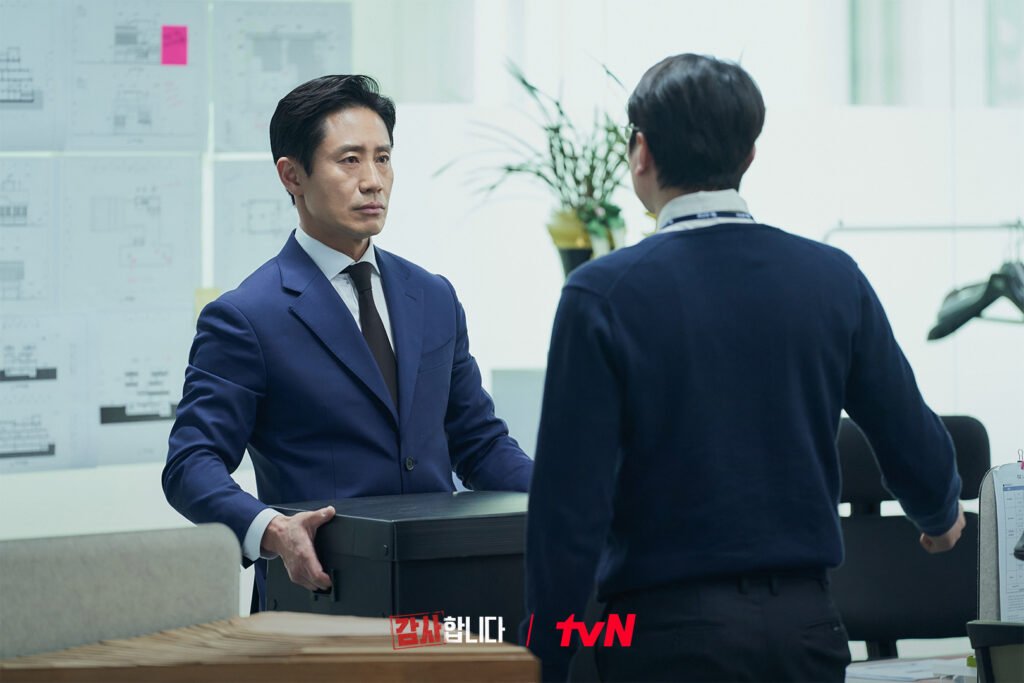
Shin Ha Kyun Is One of the Biggest Reasons to Watch
Let’s get this out of the way first:
Shin Ha Kyun is excellent.
His portrayal of Shin Cha Il is one of the strongest elements of the drama.
Cha Il isn’t the kind of protagonist who constantly smiles, gives inspirational speeches or tries to win everyone’s approval. He is serious, intimidating and extremely difficult to read.
At first, he can even seem emotionless.
But that’s precisely what makes the character interesting.
Instead of explaining everything through dialogue, the drama often allows us to understand Cha Il through his actions. He watches people carefully, notices small inconsistencies and rarely reacts emotionally when everyone around him is panicking.
Some viewers may find him too cold, but I actually think that personality is essential to the character.
Cha Il isn’t supposed to feel like an ordinary friendly office manager. He is someone who has spent years learning how to recognize lies, manipulation and corruption. His personality reflects his profession.
And Shin Ha Kyun makes that work.
There is a certain intensity in the way he looks at people that can make even a simple conversation feel like an interrogation.
The character could easily have become boring if played incorrectly, but Shin Ha Kyun gives Cha Il enough subtlety to keep him interesting throughout the series.
Goo Han Soo: Annoying at First, Better as the Story Progresses
If there is one character who might divide viewers, it’s probably Goo Han Soo.
Han Soo is inexperienced, emotional, friendly and sometimes far too trusting.
Compared with Cha Il, he can initially seem almost childish.
But I don’t think that’s necessarily a weakness.
Han Soo is deliberately written as someone who still believes that people are generally good. He doesn’t immediately understand Cha Il’s methods or why Cha Il is so suspicious of everyone.
And this creates an important contrast.
Through Han Soo, we understand Cha Il better.
If both characters were equally cold and analytical, we wouldn’t appreciate Cha Il’s personality nearly as much. Han Soo gives the audience a different perspective.
He asks the questions that a normal employee might ask.
He reacts emotionally to situations that Cha Il approaches logically.
He sometimes makes mistakes that Cha Il wouldn’t make.
Most importantly, he gradually learns.
That’s what makes Han Soo’s character arc satisfying.
Rather than being introduced as a perfect auditor, he is allowed to grow into the role.
There are definitely moments where his trusting nature can be frustrating, but I didn’t find him nearly as unbearable as some viewers might suggest.
In fact, his warmth also prevents the drama from becoming too dark and serious.
Cha Il and Han Soo Are an Unexpectedly Good Team
One of my favorite things about The Auditors is the relationship between Cha Il and Han Soo.
They aren’t the typical mentor-and-student duo where the experienced character simply teaches everything to the younger one.
Instead, they influence each other.
Cha Il teaches Han Soo how to look beyond appearances, question information and remain objective.
Han Soo, meanwhile, reminds Cha Il that people aren’t always just suspects, numbers or problems that need to be solved.
Their personalities couldn’t be more different, but that’s exactly why their partnership works.
Cha Il brings logic.
Han Soo brings empathy.
Cha Il sees the problem.
Han Soo often sees the people affected by it.
Together, they make a surprisingly effective team.
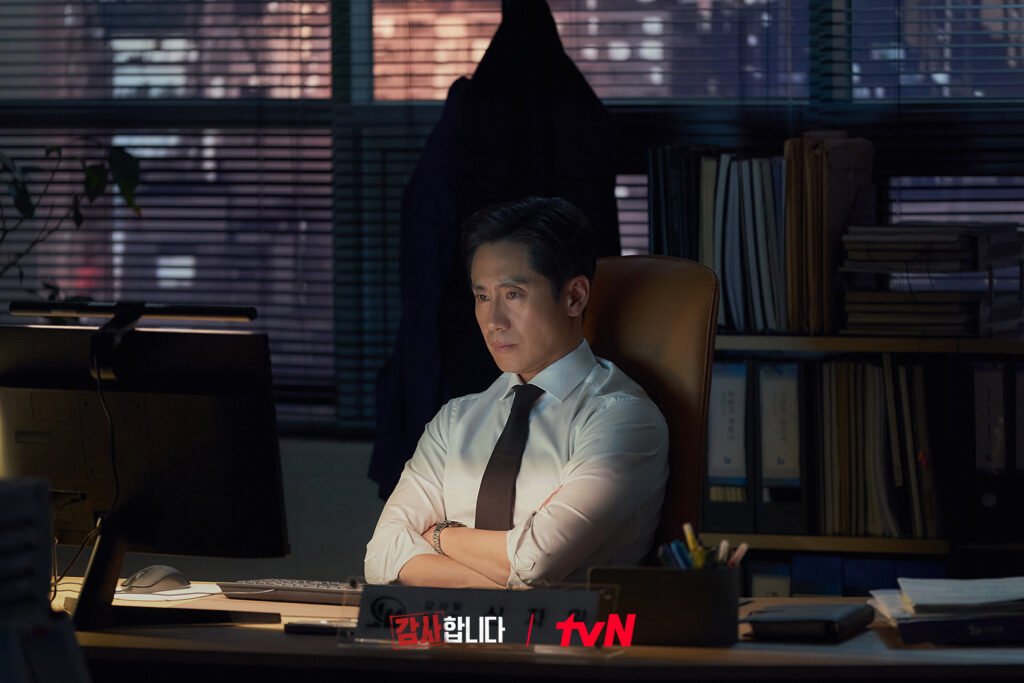
Hwang Dae Woong Steals the Show
Another character who deserves special attention is Hwang Dae Woong, played by Jin Goo.
Dae Woong is one of those characters who becomes increasingly interesting as the story progresses.
He’s confident, loud, ambitious and rough around the edges, but there is much more underneath that personality.
His relationship with Cha Il creates some of the most entertaining scenes in the drama.
Their interactions are filled with tension because neither man is particularly willing to back down.
Whenever they are in the same room, there is a sense that something could explode.
What makes their relationship especially interesting is that they aren’t simply enemies.
There is competition, suspicion, respect and curiosity between them.
Dae Woong also has his own complicated relationship with the company and his family, which gives the character additional depth.
And yes, Jin Goo’s long-haired look deserves its own appreciation.
It works ridiculously well.
The Uncle-Niece Relationship Is Surprisingly Heartwarming
The relationship between Dae Woong and Yoon Seo Jin is another emotional part of the drama.
Their dynamic isn’t overly sentimental, which makes it feel more natural.
There is genuine affection between them, and the small everyday moments—especially when they eat together or worry about each other—help show another side of Dae Woong.
For someone who can appear arrogant and aggressive in the workplace, his softer relationship with Seo Jin shows that there is a much more caring person underneath.
Seo Jin also gets her own moments to shine.
Her storyline becomes particularly emotional when she faces a scandal and finds herself caught between her personal relationships and professional responsibilities.
Rather than simply allowing other people to decide her future, she eventually learns to stand on her own.
That character development was one of the more satisfying aspects of the drama.
The Cases Keep Things Moving
The biggest advantage of The Auditors is its episodic structure.
Rather than spending the entire 12 episodes on one gigantic mystery, the drama introduces different cases involving corporate corruption, fraud, bribery, workplace misconduct and hidden schemes.
This keeps the story moving.
Whenever one case begins to wrap up, another problem appears.
Some cases are definitely more interesting than others, but the variety prevents the drama from becoming repetitive.
There is also a nice sense of satisfaction whenever Cha Il discovers something everyone else missed.
Watching him connect seemingly unrelated details is one of the most enjoyable aspects of the series.
You get that classic feeling of:
“Wait… how did he figure that out?”
And then the drama gradually reveals the answer.
Is It Realistic?
This is probably where viewers should adjust their expectations.
If you’re watching The Auditors expecting a completely realistic portrayal of corporate auditing, you may occasionally find yourself questioning what you’re watching.
The auditors sometimes behave more like detectives than actual auditors.
There are investigations, confrontations, dramatic reveals and even action sequences that make the profession look considerably more exciting than it probably is in real life.
But honestly?
That’s part of the fun.
The Auditors isn’t trying to be a documentary about auditing.
It’s using auditing as a framework for telling stories about corruption and corporate power.
And as a K-drama, it works.
The Drama Finds a Good Balance Between Seriousness and Humor
Despite dealing with corruption and workplace crimes, The Auditors doesn’t become relentlessly depressing.
Han Soo provides much of the lighter comedy, while the interactions between the main characters occasionally break the tension.
The humor isn’t always hilarious, but it helps the series breathe.
Without it, Cha Il’s seriousness could have made the entire drama feel emotionally heavy.
Instead, the series moves between investigation, workplace drama, comedy and character development.
That balance is one reason the 12-episode format works so well.
What Works Best in The Auditors?
1.Strong Lead Performance
Shin Ha Kyun carries the drama with an impressive performance as Cha Il.
His character is intimidating without constantly needing to raise his voice or become overly dramatic.
2.Great Character Contrast
Cha Il and Han Soo are complete opposites, and their differences make their partnership interesting.
3.Entertaining Cases
The different auditing cases give the drama a procedural structure while keeping the story moving.
4.Hwang Dae Woong
Jin Goo brings a lot of personality to the drama. Dae Woong is complicated, entertaining and unpredictable.
5.Short Episode Count
At only 12 episodes, the drama doesn’t require a huge time commitment.
For viewers who don’t want a 16- or 20-episode drama, this is a major advantage.
6.Character Development
The characters aren’t completely static. Han Soo especially grows significantly as he learns what it actually means to be an auditor.
What Could Have Been Better?
Of course, The Auditors isn’t perfect.
Some cases are stronger than others, and the pacing occasionally slows down.
There are also moments when the investigations become overly dramatic.
If you’re familiar with corporate auditing or expect strict professional realism, some of the investigative methods may feel exaggerated.
Han Soo can also be frustrating at times because of how trusting he is.
And while the drama does a good job developing its major characters, some supporting characters could have benefited from more depth.
The series sometimes feels like it has enough material for a longer story but chooses to move quickly because of its 12-episode structure.
Still, these issues never completely destroy the viewing experience.
Should You Watch The Auditors?
If you’re looking for a traditional romance-heavy K-drama, probably not.
Romance is not the main attraction here.
But if you enjoy:
- Corporate corruption stories
- Mystery and investigation
- Office dramas
- Strong character dynamics
- Crime and fraud cases
- Smart, serious protagonists
- Episodic storytelling
- A little comedy mixed into a serious plot
then The Auditors is definitely worth adding to your watchlist.
What makes it particularly enjoyable is that the drama doesn’t depend entirely on one mystery.
Instead, it gives you different cases, different conflicts and different character relationships while slowly developing the main cast.
Final Thoughts
The Auditors may not completely reinvent the office K-drama, but it doesn’t need to.
What it does is take a relatively unusual setting—corporate auditing—and turn it into an entertaining combination of mystery, workplace politics, corruption, comedy and character drama.
The real strength of the series lies in its characters.
Shin Ha Kyun’s Cha Il is the serious backbone of the story, while Lee Jung Ha’s Han Soo provides warmth and emotional contrast. Jin Goo’s Dae Woong adds another layer of tension and entertainment, while Seo Jin’s storyline gives the drama some much-needed emotional depth.
The auditing cases themselves vary in quality, but they provide enough twists and conflicts to keep things moving.
And while the drama sometimes sacrifices realism for entertainment, that’s not necessarily a bad thing.
At the end of the day, The Auditors is simply a fun, well-acted corporate investigation drama with a strong cast and an interesting central partnership.
It may not be the most groundbreaking K-drama you’ll ever watch, but it’s far more entertaining than its premise might suggest.
If you went into it expecting boring office paperwork, you might be pleasantly surprised.
My Rating: ⭐ 8/10
Final Verdict: A smart and entertaining office thriller with excellent performances, engaging investigations and a surprisingly satisfying character journey. Not perfect, but definitely worth watching.